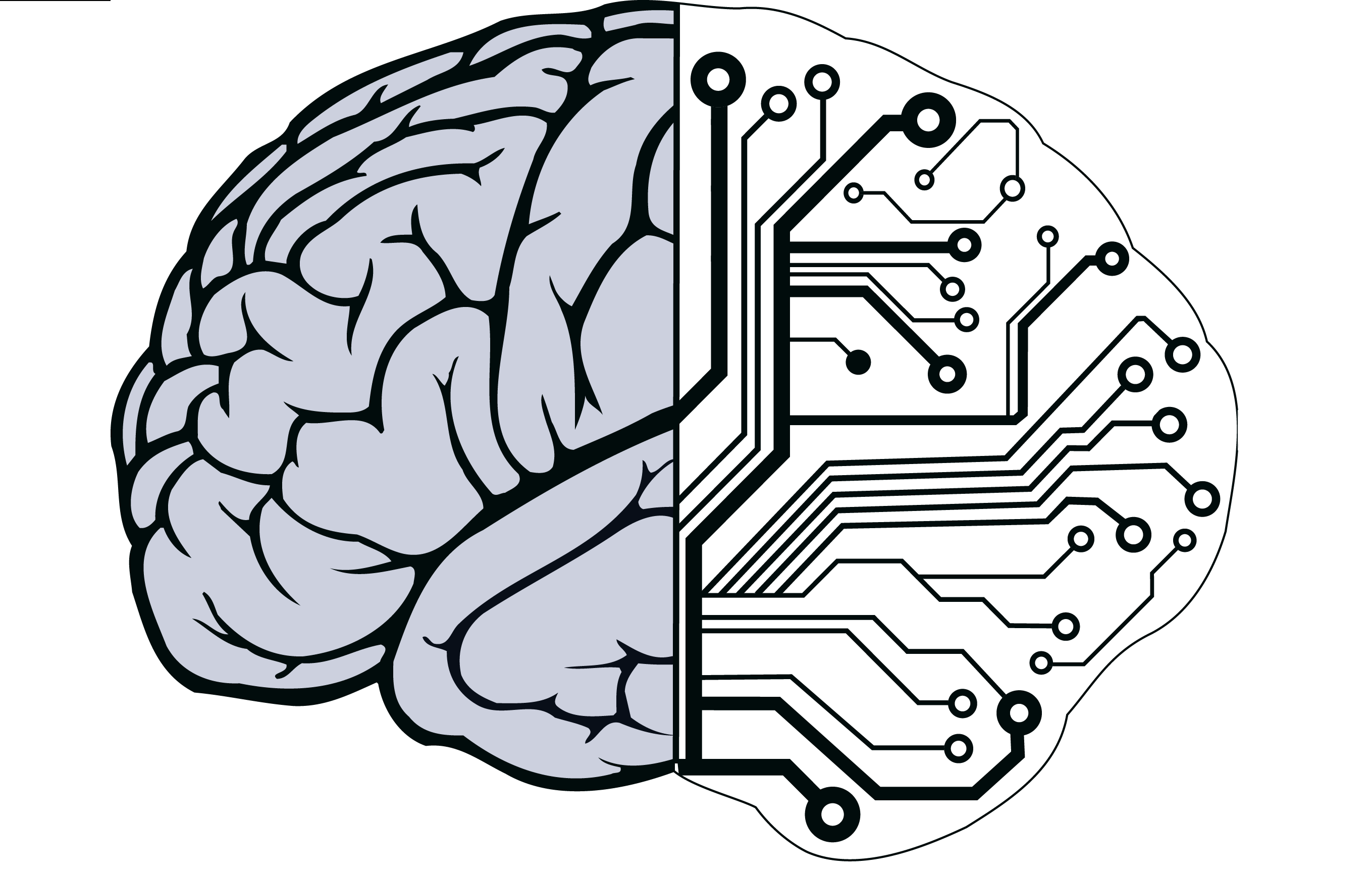
Computers are still many years away from being anywhere as intelligent as humans.
The recent advances in Artificial Intelligence, or AI, have been great, but the results have been very specific and narrow subsystems which are capable of image analysis, language processing – such as translation, calendar scheduling, stock trading, advertising optimisation and – of course – self-driving cars.
Artificial Intelligence is being predicted to overtake human intelligence at some point in the near future.
I found this unlikely – especially the “near future” part, considering 1) the number of cells in a human brain and possible connections and permutations between them, 2) the number of bits and bytes a computer can store these days 3) the processing power (operations and computations per second) of a computer 4) the amount of power a computer draws vs the amount of power a brain draws 5) the amount of time it takes a human to fully learn (i.e. circa 20 years).
But the day will come – sooner than you (and as I used to) think – when they will become much more intelligent – in many ways.
The reason for this is very simple and lies in a single principle.
Human brains are made up of cells, which interconnect, to form quadrillions of connections. It is estimated that the human brain has between 100 and 120 billion neurons, and between trillion and 2 trillion glial cells.
Compared to primates and other species, whilst not the largest, our brains have the highest density of all brains, with the highest concentration of neurons.
Density is a very important concept in efficiency.
Efficiency of anything, really. Highest density = highest efficiency.
Be it energy production, harvesting, storage or calculation.
The best motors are the ones which weigh the least amount, consume the least amount of (electrical) power and output the highest amount of mechanical power.
The most compact solar panels that collect and output the highest amount of electrical power are the most efficient.
The smallest, lightest batteries, able to store the largest amount of electrical power are the most efficient.
The smallest, lightest computer, consuming the smallest amount of electrical power, able to produce the largest amount of logical operations per second – is the most efficient.
Elon Musk recently talked about the importance of density in his Gigafactory opening speech.
The problem with human brain is that it is made up of cells.
Cells are made up of molecules – quite a lot of them. Between 5 million and 2 trillion. Each molecule is made up of atoms. Some simple molecules, like water, or H2O, contain just 3 atoms (2 hydrogen, 1 Oxygen). Others, such as proteins, contain from a few hundred to a few thousand.
Computers, especially ones that are emerging now – such as quantum, photon-based and recent atom-based data storage are working on much denser mediums than brains – instead of cells, they use molecules and atoms – being 1000’s of times denser than the human brain.
Dutch scientists have just developed rewritable memory that stores information in the positions of individual chlorine atoms on a copper surface. Each bit and byte are an atom. An atom.
That is pretty much as dense as you can get. Unless, of course, we can one day start storing data at the sub-atomic particle scale or even lower.
With such hyper-dense computers, learning will become significantly accelerated and processing power will keep growing exponentially.
We are already seeing various techniques that will allow computers and software, including operating systems, to become much more advanced and learn by themselves. So far this has been limited by computing power, electric power consumption needed for the latter and the amount and speed of storage required for machine learning.
There have been huge advances in Artificial Intelligence lately, with concepts such as Deep Learning, that allow computers to learn a whole area by themselves, without much assistance – much like humans do, if not better.
The problem with human software is that it was designed for extreme environments and with the main goal of procreation as the most basic “BIOS” or sub-operating system. We are deeply programmed for procreation, survival and often these instincts get in the way of our progress – instead of helping.
Few, through meditation and mindfulness, are able to better control our primal instincs, but for the majority the instincs remain the driving force.
Other aspects of computer advancement, such as software and now even hardware which can write, re-write and even re-wire itself are also paving the way for the super-intelligence.
Intel recently announced that they plan to add an FPGA (Field Programmable Gate Array) module to most of their future processors, suggesting that in the future many computers will have FPGA modules, if not be completely FPGA based.
(FPGA boards and circuits allow a custom “chip” to be configured by the user – versus the chip being hard coded at the factory. The configuration is done at a very low level, so the result is a very fast board, on par with a factory made custom processor for a specific task. Except that the FPGA board can be re-purposed for many tasks again and again.)
If the current rate and pace in computer advancement continues, it is likely that we will see processing and data storing density vastly superior to human in the very near future – in the next 20 to 100 years.
Compared to the 100,000 years or so that humans have been around for, these advances are extremely rapid and if the rate of hyper-intelligent computers are not far and in a few hundred years their level of intelligence is likely to be of a super-being scale.
Humans do store and process information in a very unique way, and whilst artificial intelligence will be able to process more of it and much faster – it may never be able to develop the creativity and imagination that we have. Who knows – only time will tell.
There are fear, resentment and even blind superiority that I hear a lot, associated with hyper-AI or HAI. This comes from the fear of being overtaken, becoming obsolete – whereas now many believe humans are at the top of the food chain.
A key process is understanding your own weakness and flaws, which can then lead to improvement and growth. Without these admissions, there is only stagnation, fear and jealousy.
We may well be at the top of the food chain right now, but we may not be in the future – and the future may not be so distant as we think.

 Mind Iterations